When you dial 911 from a landline, your phone system automatically ties your location to the call. The dispatcher knows exactly where you are and who to send. But with 80% of the estimated 240 million emergency calls made in the U.S. each year coming from wireless devices,1 understanding how 911 works over VoIP is essential.
In this guide, we’ll explain what E911 is, how it works, and why it should matter for any organization that uses VoIP.
E911 Meaning: What Is E911?
E911 stands for Enhanced 911. It's the system that automatically associates a physical location with a 911 call, so emergency services know where to find you.
The "enhanced" part refers to the location data. Basic 911 routes your call to a Public Safety Answering Point (PSAP). E911 goes further by transmitting your Automatic Number Identification (ANI) and Automatic Location Information (ALI) to the dispatcher – your phone number and your address, delivered automatically, without you having to say a word.
On a landline, this is seamless. Your address is permanently tied to the phone number in the carrier's database. But it's more complicated with VoIP, and that's why E911 for VoIP exists as a distinct, regulated service.
What Is an E911 Address?
Your E911 address is the physical location registered to your VoIP number, which gets transmitted to the PSAP when you call 911.
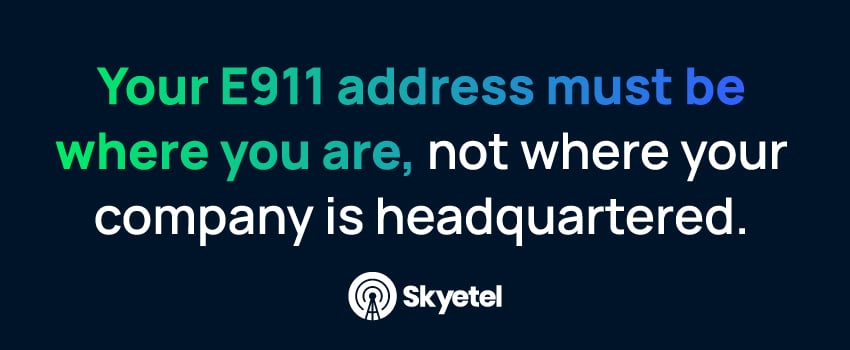
This is one of the most important concepts for VoIP users to understand: your E911 address must be where you actually are, not just where your company is headquartered.
For example, if your business has a main office in Chicago but an employee working remotely from Austin, their E911 address must be updated to reflect Austin. If they dial 911 and their address still shows Chicago, emergency responders will be sent to the wrong city.
When you’re setting up or changing an E911 address, keep in mind that:
- They must be a valid, dispatchable civic address (no PO Boxes)
- They need to be updated any time a user changes their physical location
- VoIP providers are required by the FCC to allow customers to update their E911 address at any time
Some providers, including Skyetel, support dynamic E911 address updates to make this easier for distributed teams. When employees are remote, working from temporary sites, or moving between locations, up-to-date address data can mean the difference between a fast emergency response and confusion that costs precious minutes.
E911 vs 911: What's the Difference?
People often use "911" and "E911" interchangeably, but they're not the same thing. Here’s a quick comparison:
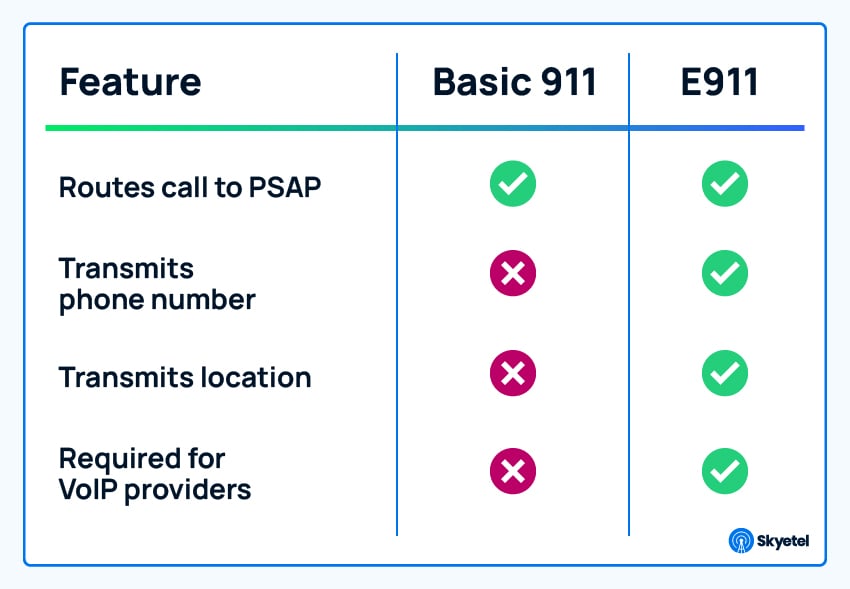 Basic 911 simply connects you to an emergency dispatcher. E911 delivers the critical location intelligence that makes emergency response faster and more accurate.
How Does 911 Work With VoIP?
When a 911 call is placed over a VoIP system, here's what happens behind the scenes:
- The call is initiated from a VoIP-enabled device (softphone, IP phone, or mobile app)
- The VoIP provider routes the call to the appropriate PSAP based on the registered E911 address
- The caller's ANI and ALI are transmitted – their number and registered location – to the dispatcher
- The dispatcher receives the call with location data already populated, enabling faster response
The key difference from a landline call is step 2. VoIP providers must maintain an accurate database of E911 addresses and route calls correctly based on those records. If that database is out of date or the address is wrong, the routing fails.
Not all VoIP providers handle E911 the same way. Some route calls through a third-party E911 service that may introduce latency or errors, while carrier-grade providers like Skyetel integrate directly with national PSAP databases to ensure accurate and reliable routing.
Our E911 service is built into the platform, not bolted on. That means when you provision a number with Skyetel, E911 registration is part of the onboarding process rather than an afterthought.
What Does an E911 Service Actually Do?
An E911 service handles the infrastructure between your VoIP system and the national 911 network. Specifically, it:
- Stores and validates your registered E911 addresses
- Routes 911 calls to the correct local PSAP based on location
- Delivers ANI/ALI data to the dispatcher automatically
- Provides call logs and confirmations for compliance purposes
Without a properly configured E911 service, a 911 call placed over VoIP could reach the wrong PSAP, reach no PSAP at all, or reach the right PSAP without any location data – all of which can cost lives.
E911 VoIP Requirements: What You Need To Know
Complying with E911 isn’t optional. The FCC’s requirements exist to ensure emergency services have the information they need, when they need it. Here’s what providers and businesses need to know:
FCC Rules for VoIP Providers
The FCC has clear requirements for interconnected VoIP providers under the VoIP E911 Order (2005) and subsequent rulings:
- All interconnected VoIP providers must offer E911 service to all customers
- Providers must transmit both the caller's ANI and registered location to the PSAP
- Providers must offer customers a way to update their E911 address at any time
- Customers must be notified of E911 limitations in writing
- Providers must obtain affirmative acknowledgment from customers that they understand those limitations
Non-compliance can result in significant FCC fines and, more importantly, real harm to people trying to reach emergency services.
E911 Requirements for Businesses Using VoIP
If your business uses a VoIP phone system, your obligations include:
- Registering an accurate E911 address for every number in your account
- Updating addresses whenever an employee moves or works remotely
- Training employees on how to update their own E911 address if your provider supports self-service
- Documenting your E911 compliance as part of your telecom recordkeeping
For businesses with large or distributed workforces, this can become a massive administrative challenge. Skyetel makes it easy with an intuitive portal that lets your teams manage addresses at the number level, plus bulk updates for accounts with high volume.
Get E911 Right From the Start With Skyetel
E911 isn't just a compliance requirement – it's a safety system that exists to protect your employees, your customers, and anyone else who might need emergency services from your business lines.
At Skyetel, we built our E911 infrastructure to meet the needs of businesses that take compliance seriously. Whether you manage five numbers or five thousand, our VoIP platform gives you instant E911 provisioning, transparent reporting, and real-time address updates that sync to the national PSAP database.
If you're migrating from another VoIP provider, we make it easy to verify and update your E911 records as part of the porting process – so there's no gap in coverage during the transition.
Ready to build your VoIP stack on a platform that takes E911 seriously? Get started with Skyetel today.
Sources: