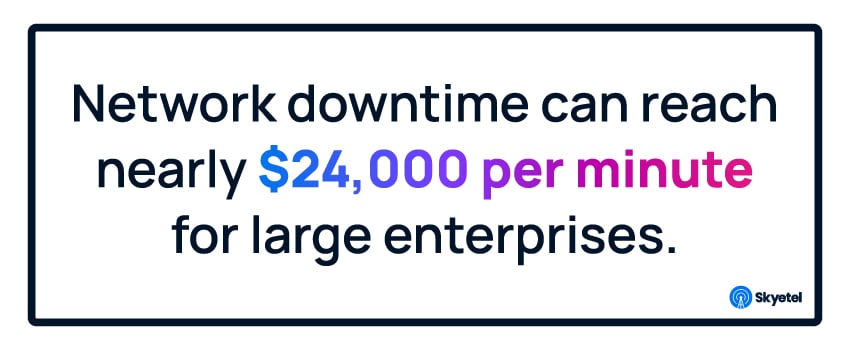
Downtime is expensive. The average cost of network downtime now exceeds $14,000 per minute for midsize businesses and can reach nearly $24,000 per minute for large enterprises1 – and that's before you factor in reputational damage, lost productivity, and the cascading effects on customers who can't reach you when they need to.
The good news is that most downtime is preventable. The answer lies in a concept that serious network engineers have relied on for decades: network redundancy.
In this guide, we’ll explain what network redundancy is, how it works, and how to put it into practice with examples from real-world infrastructure, including how we build redundancy into every layer of our network at Skyetel.
What Is Network Redundancy?
Network redundancy is the practice of building backup pathways, duplicate components, or failover systems into a network so that if one element fails, traffic or functionality automatically shifts to an alternative, with no (or minimal) interruption to users or services.
Think of it the way civil engineers think about bridges: you don't build a single support beam and hope it holds. You build redundant load paths so that failure of any single component doesn't bring the whole structure down. Network redundancy applies the same logic to routers, switches, links, data centers, and communications infrastructure.
What does redundancy mean in networking, specifically? It means that no single point of failure can take your network offline. It applies at every layer of the stack – physical links, routing protocols, hardware devices, data centers, and carrier connections.
What Does It Mean for the Routing System To Be "Redundant"? Is Redundancy a Good or Bad Thing?
A redundant routing system means there are multiple paths that traffic can take between any two points on the network. If the primary path fails, such as a router going down or a BGP session dropping, the routing protocol automatically switches to an alternate path.
Is redundancy a good or bad thing? When it comes to network design, redundancy is unambiguously good. The term sometimes carries a negative connotation in everyday language, but in networking, it means resilience. A redundant system is one that continues to function under adverse conditions, while a single-path, single-point-of-failure network is a liability.
The only trade-off is cost and complexity. Redundant infrastructure requires more investment upfront and more careful design to ensure failover works correctly. But for any organization where uptime matters – which is virtually every business today – those trade-offs are worth making.
What Is Redundant Routing?
Redundant routing refers specifically to the configuration of routing protocols and network paths so that traffic can flow through multiple routes.
Some common implementations include:
- OSPF and BGP Multi-Path Routing: These protocols maintain awareness of multiple paths and shift traffic when a preferred route becomes unavailable.
- Equal-Cost Multi-Path (ECMP): Traffic is distributed across multiple ECMPs at once, providing both redundancy and load balancing.
- Hot Standby Router Protocol (HSRP) and Virtual Router Redundancy Protocol (VRRP): These protocols allow multiple physical routers to appear as a single logical gateway, so if one router fails, another takes over instantly.
- Diverse Carrier Paths: For WAN and VoIP infrastructure, using multiple carriers with independent routing provides true redundancy at the carrier level.
So, what does redundancy mean in the context of internet routing? It means a network that maintains multiple carrier interconnects, distributed points of presence (PoPs), and automatic traffic rerouting so that no single infrastructure failure can disrupt service.
Skyetel’s reliable network infrastructure is engineered to deliver 99.999% core network uptime – a standard that requires true redundancy at every layer, not just a backup generator.
How Network Redundancy Reduces Downtime
To fully explain how network redundancy reduces downtime, it helps to understand the relationship between redundancy and the two metrics that define downtime risk: Mean Time Between Failures (MTBF) and Mean Time to Recovery (MTTR).

Redundancy improves both. By eliminating single points of failure, it reduces how often any given failure causes a user-visible outage (improving effective MTBF). And by enabling automatic failover rather than requiring human intervention to restore service, it dramatically reduces MTTR – from hours or minutes to seconds or milliseconds.
For VoIP and communications infrastructure, the math is stark. A non-redundant voice deployment might experience a full outage from a single carrier event and require 30–60 minutes to restore service manually. A redundant deployment with automatic failover might experience the same underlying failure with zero user impact.
What Are the Benefits of Building Redundancy Into a Network?
Understanding the benefits of redundancy in a network is essential for any organization upgrading its infrastructure. Here's a look at what network redundancy provides:
Dramatically Reduced Downtime
When you explain how network redundancy reduces downtime, the mechanism is straightforward: redundant systems eliminate single points of failure.
The result is that what would have been a full outage becomes a brief, often imperceptible hiccup – or no interruption at all. For VoIP and communications, this means calls don't drop, customer service lines stay live, and emergency services remain reachable.
Improved Performance Through Load Distribution
Redundancy isn't just about failover – it also enables active load balancing. Multiple active network paths distribute traffic across links, reducing congestion and improving latency so that users experience faster and more consistent performance, even during peak traffic periods.
Business Continuity and Disaster Recovery Readiness
Redundancy is the foundation of any serious business continuity or disaster recovery plan. Building redundancy into a network means your organization can continue operating through hardware failures, natural disasters, cyberattacks, and carrier outages – the scenarios that test whether your continuity plan actually works.
For organizations that rely on carrier-grade voice and messaging, this is non-negotiable. At Skyetel, we built out a SIP trunking platform with geo-redundant failover specifically for this reason: when your primary systems are under stress, your communications should be the last thing that goes down.

Enhanced Security Posture
Redundant networks are also more resilient against distributed denial-of-service (DDoS) attacks and other threat vectors. When an attack floods one path or node, traffic can reroute around the affected area.
Combine this with carrier-grade security and fraud protection, including STIR/SHAKEN compliance and active fraud monitoring, and you have a communications infrastructure that's hardened against both infrastructure failures and deliberate attacks.
Scalability Without Fragility
A redundant network is inherently easier to scale. Adding capacity to a redundant architecture means adding to existing resilience rather than expanding single points of failure. As organizations grow, their infrastructure grows with them without increasing the blast radius of any single failure.
4 Real-World Network Redundancy Examples
Let’s explore a few network redundancy examples to see what these concepts look like in practice:
- Healthcare: A regional hospital network routes patient-facing phone calls through a SIP trunking platform with multiple carrier interconnects and geographic failover. If a fiber cut takes out their primary internet connection, inbound calls automatically reroute through a secondary path.
- Finance: A financial services firm runs its trading desk communications through redundant VoIP infrastructure that spans two data centers in different states. When a power event at one facility triggers automatic failover to the secondary site, traders never notice the underlying failure.
- Contact Centers: A customer support center uses ECMP across multiple carrier connections to distribute call traffic during peak hours. Whenever one carrier experiences congestion, traffic switches to less congested paths so that calls can maintain consistent quality.
- Enterprise IT: A large enterprise with distributed offices leverages redundant BGP peers with diverse upstream providers. If a BGP session drops with one provider, the routing protocol reconverges in seconds, enabling traffic to flow through the alternate peer.
These are the kind of situations our customers face regularly, and why we've built our origination and termination services on infrastructure designed to handle real-world failure conditions – not just ideal-case traffic.
What Does Redundancy Mean in Networking?
Understanding what redundancy means in networking also means knowing how to evaluate the redundancy claims of your infrastructure vendors and carriers. Not all redundancy is created equal. Key questions to ask:
- Does your carrier own its own network, or does it resell capacity from an upstream provider? If they resell, their redundancy is only as good as their upstream provider’s network.
- Are their redundant paths truly diverse – physically separate routes, separate facilities, separate upstream connections – or just logically separate on the same physical infrastructure?
- What is their documented failover time? Seconds? Minutes? Is it tested and proven or theoretical?
- Does their platform support automatic rerouting, or does failover require a support ticket?
- Are their E911 services redundant as well – including for remote or distributed workers? This matters more than most organizations realize until they need it.
As a true carrier, we own our network. That distinction matters for redundancy: we have direct control over routing decisions, interconnects, and failover behavior – not a dependency on a provider we don't control. Our platform overview covers the full scope of what that means for voice, messaging, fax, and API-driven communications.
Build a Resilient Network Foundation With Skyetel
Network redundancy is a baseline requirement for any organization that depends on reliable communications – and today, that means every organization. The cost of building redundancy is almost always less than the cost of a single significant outage. And the competitive advantage of staying operational when others go down is difficult to overstate.
At Skyetel, we built redundancy into our network from the ground up with geo-redundant infrastructure, carrier-owned interconnects, automatic failover, and 99.999% uptime since 2014. Whether you're evaluating a new SIP trunking provider, designing a communications continuity strategy, or looking for a carrier that can actually back up its uptime claims, we're ready to have that conversation.
Get started with Skyetel and see what carrier-grade network redundancy looks like in practice.
Sources: