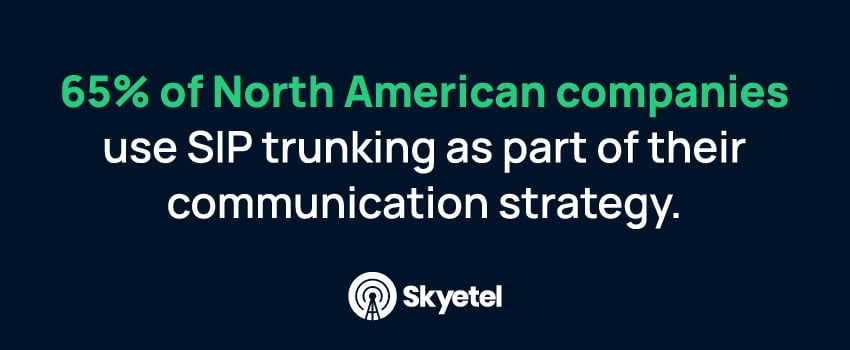
If you've spent any time researching modern business phone systems, you've probably come across the term SIP trunking. With 65% of North American companies using SIP trunking as part of their communication strategy,1 it often comes up in conversations about VoIP, unified communications, PBX upgrades, and cost reduction – and for good reason.
SIP trunking is the backbone of how most businesses make and receive calls today. But for all the attention it gets, it's often explained poorly. This guide covers what SIP trunking is, what it's used for, and how to evaluate providers worth trusting with your voice infrastructure.
What Is a SIP Trunk?
A SIP trunk is a type of virtual phone line that connects a business phone system to the PSTN (Public Switched Telephone Network) via the internet. While traditional phone lines run physical wires into your office, a SIP trunk uses your internet connection to carry voice calls as digital packets.
The "trunk" in SIP trunk is a holdover term from legacy telephony, where a single physical trunk could carry multiple calls at once. This same concept applies with SIP – one trunk can handle hundreds of concurrent calls – but it's all handled over IP infrastructure instead of copper.
SIP stands for Session Initiation Protocol. It’s a signaling protocol that controls how voice sessions are started, managed, and ended over IP networks. When someone dials your business number, SIP is the protocol that routes the call and establishes the audio session.
At Skyetel, we offer carrier-grade SIP trunking built on a network we own and operate – which means you're not relying on a reseller or a third-party backbone when it matters most.
How Does SIP Trunking Work?
Understanding how SIP trunking works means understanding a few basic pieces and how they connect:
- IP PBX or UCaaS Platform: Your internal phone system, whether it's an on-premise PBX like 3CX or FreePBX, or a cloud-based UCaaS platform, acts as the hub for internal call routing.
- SIP Trunk: The connection between your PBX and the carrier. It handles outbound and inbound calling to and from the PSTN.
- Carrier Network: The provider's infrastructure that connects your SIP trunk to the wider phone network. Not all carriers own their own network – and that distinction matters enormously for reliability.
- DIDs (Direct Inward Dial Numbers): The phone numbers associated with your trunk. You can have local numbers, toll-free numbers, and numbers across multiple area codes, all routing through the same SIP trunk.
When a customer calls your business number, their call enters the PSTN and reaches your SIP trunk provider's network. The provider routes the call to your IP PBX via SIP signaling, which connects the caller and transmits the audio as RTP (Real-time Transport Protocol) packets over your internet connection. When the call ends, SIP terminates the session.
Outbound calls follow the reverse path. Your PBX initiates the SIP session, the trunk routes the call out through the carrier's network, and it connects to the recipient's number on the PSTN.
Because the entire process runs over IP, you need a stable internet connection and a provider with a geo-redundant backbone. Our network infrastructure at Skyetel delivers 99.999% uptime – not because we promise it, but because we own the network and have never had an outage.
What Is SIP Trunking Used For?
SIP trunking isn't a single use case – it's core infrastructure that supports a wide range of communication needs. Here's a look at the most common applications.
Replacing Legacy PSTN Lines
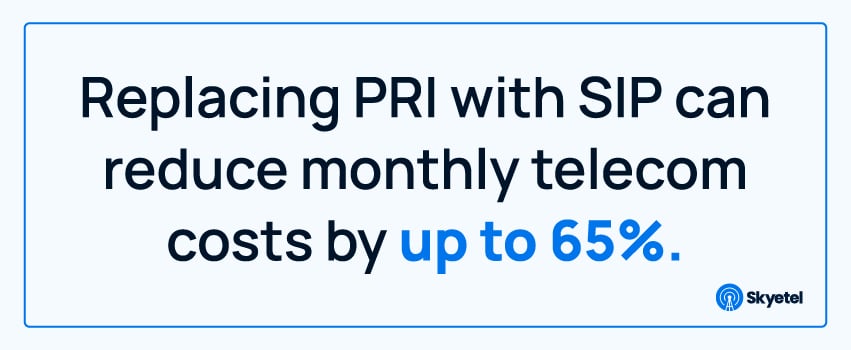
The most straightforward use of SIP trunking service is replacing traditional analog or PRI (Primary Rate Interface) phone lines. This alone typically cuts monthly telecom costs between 25% and 65%,2 or even more, depending on call volume and the previous carrier's pricing.
Connecting IP PBX Systems To the PSTN
If your business runs an on-premise IP PBX like Asterisk, FreePBX, 3CX, or a similar platform, SIP trunks are how you connect it to the outside world. The PBX handles all your internal routing logic; the SIP trunk handles getting calls in and out.
Microsoft Teams Direct Routing
Organizations using Microsoft Teams for internal communications can extend it to handle external calls via Direct Routing, and SIP trunking is the underlying connection. Skyetel supports Teams Direct Routing with the same carrier-grade reliability as our standard SIP trunks.
Disaster Recovery and Failover
SIP trunks are a natural fit for business continuity planning. Because calls are delivered over IP, they can be instantly rerouted to backup locations, remote workers, or mobile numbers if your primary site goes down. Our geo-redundant infrastructure makes failover transparent – calls keep moving even when something breaks.
Multi-Location and Remote Work
For businesses with multiple offices or distributed teams, SIP trunks eliminate the need for separate phone service at each location. A centralized trunk – or a network of trunks – feeds your entire organization, with calls routed intelligently based on location, time of day, or workload.
High-Volume Call Centers
Contact centers and high-volume inbound operations depend on SIP trunks to handle concurrent call loads that legacy lines simply can't scale to. SIP trunks can scale elastically – add capacity when you need it, without waiting on a technician or signing a new contract.
SIP Trunking Benefits and Best Practices
Cost savings from SIP’s usage-based billing are usually the first thing businesses notice after switching, but SIP trunking benefits go far beyond reduced costs. Here's the full picture:
- Scalability: SIP lets you add or remove channels on demand. There's no waiting on hardware provisioning or minimum seat commitments with a provider like Skyetel.
- Geographic Flexibility: With SIP, businesses can use numbers from any area code, no matter where their offices are physically located.
- Built-In Compliance: STIR/SHAKEN authentication, HIPAA-ready infrastructure, and advanced fraud prevention come standard with Skyetel SIP trunks, not as expensive add-ons.
- Reliability: With a true carrier – not a reseller – you get direct routing and fewer points of failure.
- Simplified Management: Manage your numbers, routing, and usage from a single dashboard. No juggling multiple vendors or outdated portals.
 However, getting the most out of your SIP trunking deployment means more than picking a provider. These best practices separate businesses that thrive on SIP from those that run into trouble:
Prioritize Voice Traffic on Your Network
SIP calls are sensitive to latency, jitter, and packet loss. Without QoS (Quality of Service) rules on your router and firewall, voice packets compete with data traffic – and calls suffer. Configure QoS to prioritize RTP audio traffic on any network where SIP trunks are in use.
Size Your Bandwidth Correctly
A G.711 codec call uses roughly 85–90 kbps per concurrent call. G.729 compresses further but may affect audio quality. Know your peak concurrent call volume, then add headroom. As a general rule, calculate 100 kbps per channel and ensure your internet connection can handle it comfortably.
Choose a Provider That Owns Its Network
Most SIP trunk providers are resellers, which means they buy capacity from carriers and mark it up. When issues arise, you're waiting on their vendor to respond, not an engineer with direct access to the infrastructure.
Skyetel operates as a true carrier. We own our network, control our routing, and hold our own numbering authority. That's not a marketing distinction – it's what makes the difference during an outage.
Test Failover Before You Need It
Disaster recovery only works if it's been tested. Regularly simulate primary site failures and verify that calls route correctly to your backup destination. Update your failover routing and confirm it behaves as expected before you have to rely on it in a real incident.
Keep Compliance Requirements Front of Mind
If you operate in healthcare, finance, legal, or government, your SIP trunking provider needs to meet specific compliance standards.
Our platform supports HIPAA-ready configurations, STIR/SHAKEN compliance for call authentication, and E911 for emergency routing – so compliance doesn't require a workaround.
What Is SIP Trunking Service, Really?
The term "SIP trunking service" gets used broadly, but there are a few major differences between carriers and resellers, premium-grade infrastructure and commodity VoIP, and vendors who answer the phone and those that don't.
When evaluating providers, ask:
- Do they own their network, or are they reselling someone else's capacity?
- What does their SLA look like, and can they point to a real uptime record?
- Is compliance (STIR/SHAKEN, HIPAA, E911) built in or added on?
- What does support actually look like – live engineers, or a ticketing queue?
- Is pricing transparent, or are there hidden fees for porting, storage, or other basic features?
Skyetel’s SIP trunking platform is designed for enterprises, resellers, and service providers who need a carrier partner that scales with them and performs when it counts – not just a commodity dial tone.
See the Difference a True SIP Trunking Carrier Makes
SIP trunking has reshaped business communications by lowering costs, improving flexibility, and making it easy to build voice infrastructure that actually scales. But the technology is only as good as the provider delivering it.
Skyetel’s carrier-grade network delivers 99.999% uptime, direct carrier control, transparent pricing, and the kind of hands-on support that's rare in this industry. Whether you're migrating away from legacy PRI lines, building out a multi-tenant platform, or replacing an unreliable provider, our platform is built to meet your needs.
Ready to see the difference working with a true carrier makes? Get started with Skyetel today.
Sources: